

Before, During, After: The Three Moments That Make a Lesson Impactful
For teachers, and the leaders who support them
By Faith Ware, Vice President, Teaching & Learning, Specialized Education Services, Inc. (SESI)
Confession Time: The Perfect Lesson Plan That Wasn’t
We’ve all written it. The lesson plan that looks flawless at 9 p.m. The objective is crisp. The activity is clever. Then, twelve minutes into the lesson, half the class is making the exact same mistake, one student is under the table, and you realize the plan never answered the question “what if this doesn’t work?”
If you lead a school or a program, you’ve likely seen the other side of that moment: the plan that looks great in the shared folder and looks different in the room. Neither of you did anything wrong. A plan is only one of the places a lesson lives.
Here’s the good news: that moment isn’t a sign you’re a bad teacher. It’s a sign that impactful lesson delivery lives in more than the forty-five minutes you spend teaching. It happens before, during, and after the lesson, and each moment matters. For teachers, that means knowing what to do in each one. For leaders, it means knowing where to look for each one, and what to do when you find a gap.
Why It Matters Most for Students with Learning Differences
Students with exceptional needs have less room for “close enough.” A lesson that’s too fast, too vague, or missing a support can lose a learner in minutes. That’s why we think about lesson delivery through our Support, Prevent, Connect framework:

Support: We teach social, emotional, and behavioral skills the same way we teach academics, with modeling, practice, and feedback.

Prevent: Clear expectations, behavior-specific feedback, and function-based thinking built into daily routines head off challenges before they start.

Connect: Consistent, fair, and predictable adult responses build trust with students.
It’s also grounded in the field’s research. Our approach draws on several of the High-Leverage Practices from the Council for Exceptional Children and the CEEDAR Center, including designing instruction toward a goal, scaffolding, explicit instruction, and teaching for generalization. Teachers and leaders look at the same practices, which is what makes the conversation between them so useful.
One Lesson, Three Places to Look
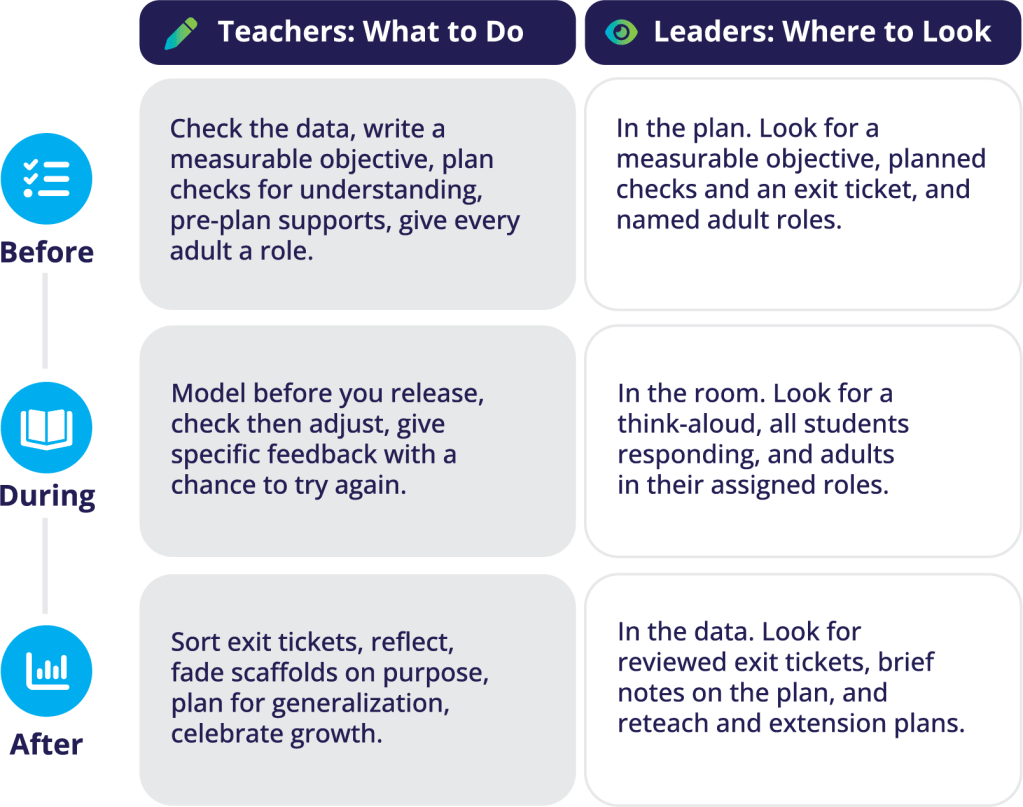
The Before: Planning Is Where the Magic Starts
The most impactful teachers often look the calmest in the room, and that’s usually because the hard thinking happened earlier. A few planning moves make the biggest difference:
- Do a quick data check. Last week’s exit tickets, progress monitoring, and IEP goal data tell you where to start, so you’re not guessing.
- Write a measurable objective. A helpful formula: “By the end of the lesson, students will [do what] + [with what] + [how well].” If you can’t measure it, you can’t know whether it worked.
- Plan your checks for understanding in advance. “Does everyone get it?” isn’t a check. A whiteboard response, a “find the error” task, or a 30-second turn-and-teach is.
- Pre-plan supports. Universal Design for Learning (UDL) asks us to build in multiple ways to access content and show learning from the start, so fewer students hit a barrier at all.
- Give every adult a role. If there’s a classroom assistant and/or paraprofessional, they should know exactly what they’re doing and when.
For leaders: the before
The before is the one phase you can see without stepping into a classroom. When you review a plan, look for the core components (opening, objective, gradual release, check for understanding, and closure), named adult roles, and an exit ticket written in. Plan format can flex: digital, handwritten, and template-based plans all count.
A coaching tip: start with something specific the plan does well, then choose one next step. A plan that says “differentiate as needed” needs one concrete support named, not a rewrite.
The During: Teach It, Check It, Adjust It
Delivery is where the plan meets real students. Three habits keep it on track:
- Model before you release. The “I do, we do, you do” sequence works because students watch the thinking first (“Watch me. I’m going to underline the key words and choose my operation”), try it together, then try it alone. Skipping the first two steps is the fastest route to a frustrated class.
- Check, then adjust. Imagine you model finding the main idea, then ask students to write it on a whiteboard. Seven of ten got it. Three wrote a detail instead. That quick scan lets you move forward and know exactly who to check in with next. Even better: decide in advance what will trigger a change (e.g., “if more than half the class is off-task, I’ll reteach with a new example”).
- Give feedback that is specific. “Good job” feels nice. “You found a quote that proves your answer. Now let’s explain why it works” teaches. Pair it with a chance to try again.
If this sounds familiar, it should! Frequent opportunities to respond are the engine that makes all of these checks possible.
For leaders: the during
This is the part you can only see by being in the room, and it’s where a strong plan can quietly drift. Picture a fictional middle school functional math lesson with a measurable objective, a planned think-aloud, and three planned checks. In the room, the hook runs long, the objective is never stated, the think-aloud is skipped, and the planned check becomes “everyone got it?” Three of seven students meet the objective. Reviewing the plan alone would not have caught that.
A strong first move is one focus, not five fixes. Decide in advance what to cut when time runs short, write that rule on the plan, and protect the “we do” and the check for understanding. Then show, don’t just tell: model a think-aloud, huddle with the aides about their roles, and come back to watch that one part.
The After: Where Growth Actually Happens
This is the part most of us skip, because time is short, and we feel like we need to move on to the next thing. But the “after” is how today’s lesson improves tomorrows.
- Sort your exit tickets into three piles: “Got it,” “Almost,” and “Needs reteaching.” Then plan accordingly, with a different example or modality for the reteach group and a challenge for those ready for more. (Re-teaching the same lesson the same way is the one thing the data tells us won’t work.)
- Take two minutes to reflect. What worked? Where did students struggle? Jot a note right on your lesson plan.
- Fade scaffolds on purpose. Remove one support at a time. Drop the sentence frame but keep the word bank. Scaffolds are meant to be temporary because the goal is independence.
- Plan for generalization. Can students use the skill with a new text, in a different subject, or with a different adult? That’s the real finish line.
And then it’s party time! We can’t forget to celebrate growth. Pointing out that an exit ticket went from 2 out of 5 to 4 out of 5 is the kind of news that deserves a drumroll. Students who can see their own growth are far more likely to keep going for more.
For leaders: the after
The after is the easiest phase to skip and the hardest for a leader to see, because it lives in artifacts: sorted exit tickets, notes on a plan, a reteach group. It is also where the biggest gaps tend to hide. In a fictional site roll-up of six classrooms, most of the before and during look-fors were in place, but only a small share of the after look-fors were.
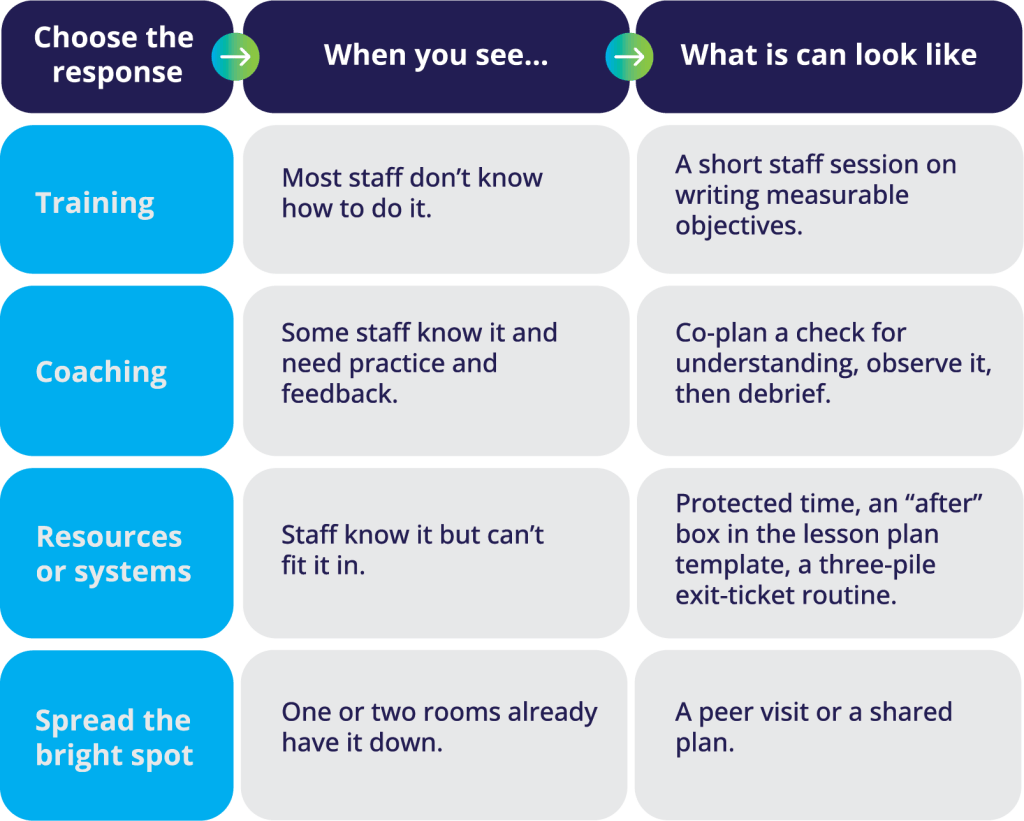
What do you do with a pattern like that? Match the response to what the data shows. If the after is thin because staff don’t have the time rather than the know-how, more training won’t fix it. A system will.
Try This: One Move for Your Next Lesson
Think about your last lesson, or the last one you observed. Which of the three moments was your strongest, and which got the least attention? Pick one small action from the weakest one:
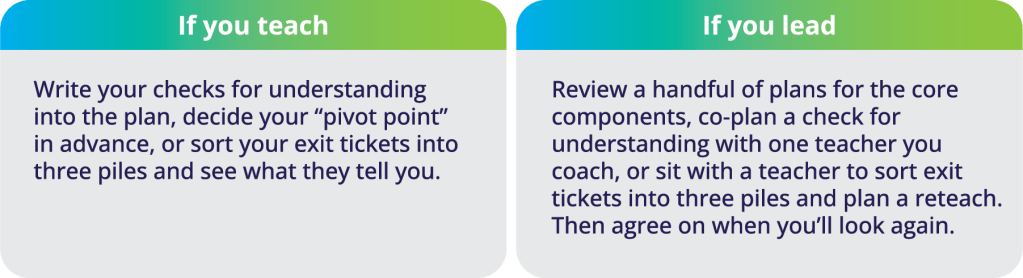
Pick one or two moves, not eight. A good goal is small enough to start this week, specific about who and when, and visible: something you can show or count.
Here’s the secret nobody tells you. The best lessons rarely go exactly as planned. They go the way the students need, because the teacher was ready. And teachers are more likely to be ready when the people supporting them know where to look, what to say, and how to make the work smaller.

About the author: Faith Ware leads SESI’s Teaching & Learning team, driving instructional leadership, special education programming, and large-scale program development. She specializes in compliance, instructional development, and leadership training that helps schools support diverse learners.
Related Resources
-
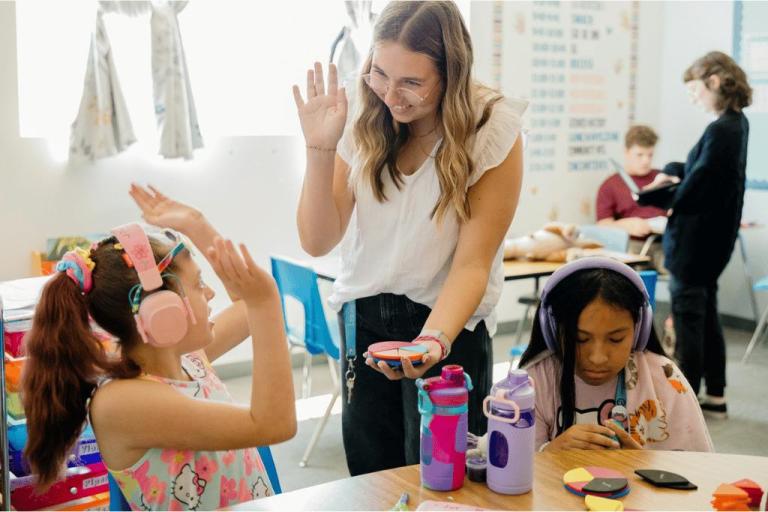

12 Strategies for Supporting Student Behavior
Dr. Diane Myers shares 12 evidence-based strategies for responding to student behaviors that do and do not meet expectations.August 26, 2026 -
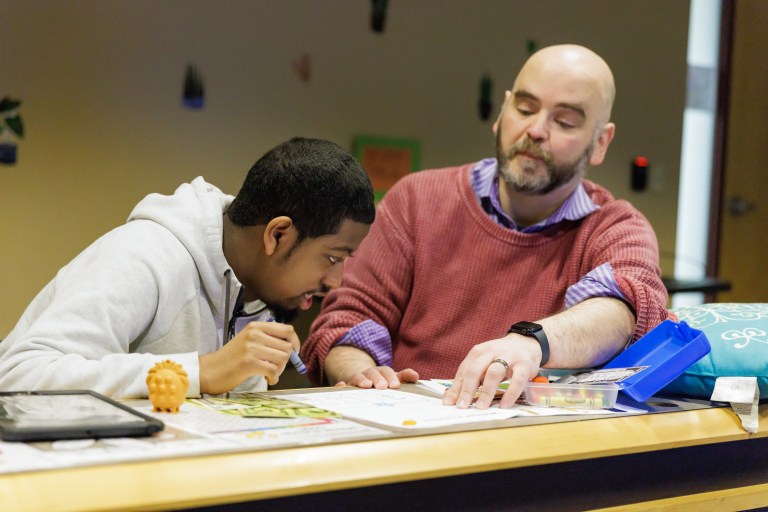
Engaging Every Student: Four Opportunities to Respond in Special Education
A teacher asks a question, three eager hands go up, one student answers, and the class rolls on. It looks like engagement, but for everyone who never had to commit to an answer, it isn’t. For students with learning differences especially, one simple practice can close that gap: opportunities to respond.October 9, 2026 -
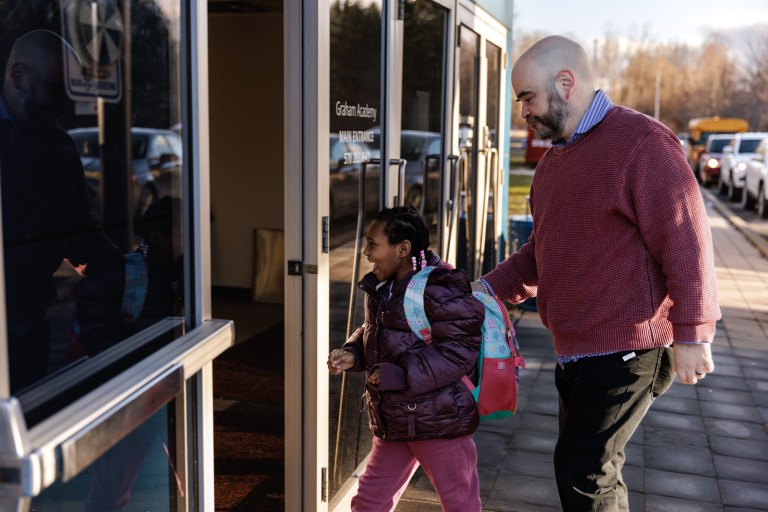
Say What You Want to See: Proactive Behavior Support That Works
Brittany Croteau shares evidence-based strategies for teaching clear expectations and using proactive, actionable language to support student behavior.October 30, 2026