

Say What You Want to See: Proactive Behavior Support That Works
By Brittany Croteau, MSW, LCSW-C, Specialized Education Services, Inc. (SESI)
Why “Stop Running” Isn’t Effective
A student sprints down the hallway. A staff member calls out, “Stop running!” The student slows down, looks at the teacher, walks a few steps, and then resumes running.
The staff member isn’t wrong: we do want the student to stop running. When we say, “Stop running,” we tell the student what not to do, but we haven’t provided any information about what the student should be doing. We should be clear about what we expect when the current behavior doesn’t meet expectations. Proactive behavior support is about making it as easy as possible for students (and staff) to meet expectations. We teach, provide opportunities for practice, and reinforce the behavior we want to see so students always understand what they should be doing across all contexts.
At SESI, our Support, Prevent, Connect framework helps students understand what’s expected and makes it as easy as possible for them to meet all expectations.

Support: We teach social, emotional, and behavioral skills the same way we teach academics, with modeling, practice, and feedback.

Prevent: Clear expectations, behavior-specific feedback, and function-based thinking built into daily routines head off challenges before they start.

Connect: Consistent, fair, and predictable adult responses build trust with students.
How do we know it works? We rely on the Council for Exceptional Children’s High-Leverage Practices to shape our instructional model, and three of the high-leverage practices point to clear expectations:
- HLP #7: Establish a consistent, organized, and respectful learning environment.
- HLP #8: Provide positive and constructive feedback to guide students’ learning and behavior.
- HLP #9: Teach social behaviors.
We know that most behaviors are learned, which means that most behaviors can be taught. Social behaviors can be taught just like academic behaviors. After all, we wouldn’t just tell students to “do math.” We’d provide specific instructions about what to do. If they made an error, we wouldn’t say, “stop adding incorrectly” (we hope!). We’d help the student see the error and let them try again, provide guidance, and, if needed, reteach the skill. We should take the same approach with social behaviors. Students need to hear the expectation, see what it looks like, practice it, and get feedback, just like any other skill.
Start With Expectations Students Can Actually Use
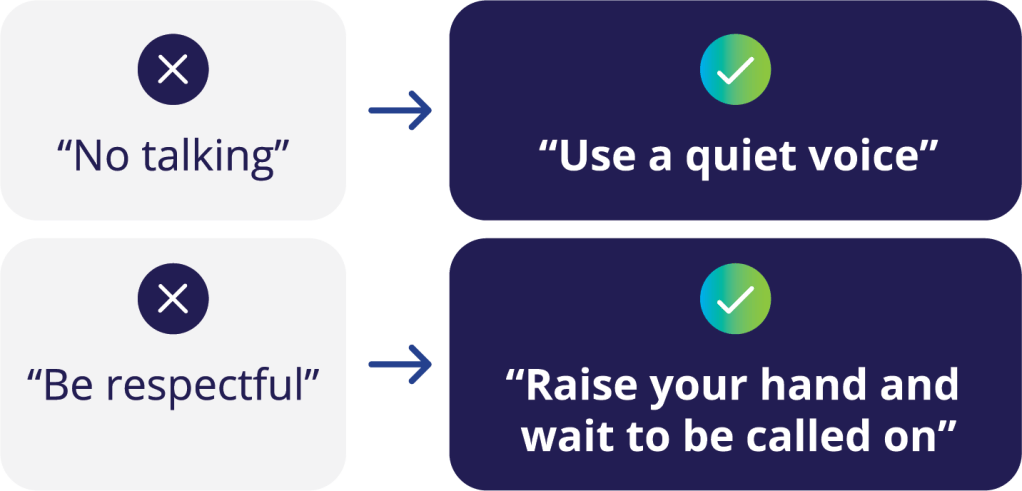
At SESI expectations (which we also call “norms”) are stated as actions, are specific enough to see or hear, and show up where routines happen. Compare these non-examples and examples:
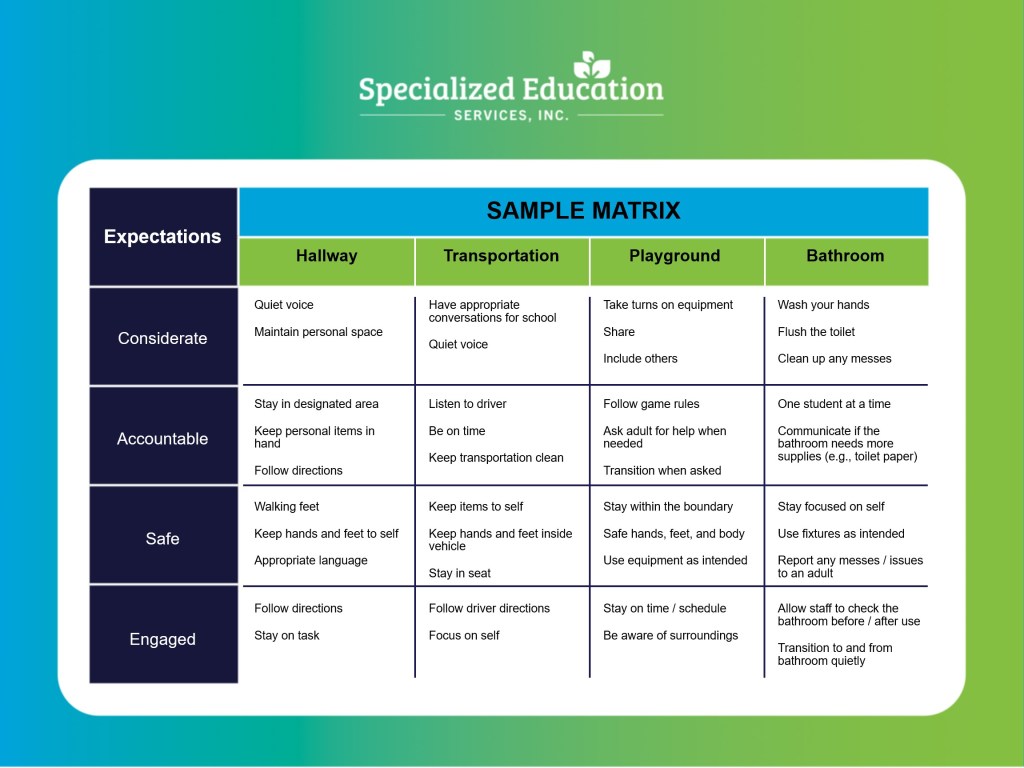
Once norms are established, we can use a simple matrix to define what each one looks like in each routine, such as arrival, hallways, restrooms, and common areas. Staff members can refer to the matrix, teach from it, and use it in the moment to recognize behavior that meets expectations and redirect those behaviors that don’t. To make the norms even easier to follow, have students help shape them. Solicit their input when identifying actionable expectations, which promotes their buy-in and gives space for their voices to be heard. In addition, ensure every student can access them. Pair norms with pictures, put a matrix on a student’s desk, and build expectations into a communication devices.
Practice the “Four R” Method
While “Good job” or “Stop” may be easy statements in the moment, more feedback for our students increases the likelihood of their success. We want to give our students a roadmap for which behaviors earned praise or redirection, and which behaviors to repeat (or avoid) next time. Behavior-specific language is the key to unlocking expected behaviors: we name the behavior, use positive and actionable words, and describe something we can see or hear. We can use the four Rs as a framework:
- Remind: Pre-correct before the routine. (“When we line up, walk and keep your hands to yourself.”)
- Reinforce: Narrate what’s going well. (“Aaron, thanks for working quietly at your desk.”)
- Redirect: Tell students what to do. (“Mark, use polite language. Do you need some help?”)
- Review: Have a conversation about the students’ performance at the conclusion of the routine – and tie to points. (“Lisa, at the start of geometry you brought your materials straight to the group table, you earned a 2 for being Accountable.”)
One note: if a behavior is unsafe, a quick “Stop!” is an entirely appropriate response in the moment. Just remember to remind the student what they should do after.
Read the Behavior Before You React to It
Behavior is communication: students are usually trying to get something or avoid something. Looking at what happens before the behavior itself (i.e., the antecedent), and what happens after (i.e., the consequence) helps us predict and prevent behaviors and plan for effective intervention.
Imagine a class where students tend to use loud voices and engage in off-task behaviors every day after lunch. The teacher has tried redirection (“Remember to use your quiet voices in the classroom!”) but it has not impacted the students’ behavior. Since it’s a daily occurrence, the antecedent could be the lunch-to-classroom transition and/or the start of independent work; the function may be peer attention and/or avoiding the work. With this information in mind, the teacher may design a new transition routine where there’s a moderately preferred activity between lunch and independent work (e.g., a group read aloud), a precorrection, and a quick, structured movement break. We can design more effective interventions to meet students’ needs and increase the likelihood of behavior that meets expectations!
Something to try this week:
- If any classroom rules contain “no,” “stop,” or “don’t,” rewrite them using actionable language: what should students do?
- Follow up any “good jobs” with behavior-specific statements: what did the student do that was “good?”
- Spot-check visual expectations. Are they accessible to all students? Are they in easy-to-see locations? Do they reflect student voice? Have a revision session with students if needed!
- Have students select a routine and teach it to each other, then find examples of peers engaging in expected behavior throughout the day.
- Remember: social behavior can be taught just like academic behavior. The first step is making sure students know exactly what we’re looking for – and the tips above can help us do just that!

About the author: Brittany Croteau is SESI’s Senior Director of Integrated Support (Therapeutic), leading regional training and development that strengthens the systems helping students, clinicians, and school teams thrive. An LCSW-C with a master’s degree in Social Work, she brings more than a decade of SESI experience to professional development and coaching in the social-emotional learning space. She is passionate about building environments where clinicians feel supported and students receive consistent, high-quality services.
Related Resources
-

12 Strategies for Supporting Student Behavior
Dr. Diane Myers shares 12 evidence-based strategies for responding to student behaviors that do and do not meet expectations.August 26, 2026 -
Engaging Every Student: Four Opportunities to Respond in Special Education
A teacher asks a question, three eager hands go up, one student answers, and the class rolls on. It looks like engagement, but for everyone who never had to commit to an answer, it isn’t. For students with learning differences especially, one simple practice can close that gap: opportunities to respond.October 9, 2026 -

5 Tips for Fostering a Positive Learning Environment for Students with Autism
Creating a positive environment for students with autism is essential for their academic and social development. Learn more about the effective strategies that encourages positive social interactions between students and educators.April 4, 2024